Press play to watch/listen to changing symptoms of MS or scroll to continue reading.
Recently, I received an invitation to be a panellist on a webinar sharing my lived experience of the changing symptoms of multiple sclerosis.
What is multiple sclerosis?
Below is from the MS Society’s website and is there information the MS nurses provide on the helpline?
Multiple sclerosis (MS) is a condition that affects your brain and spinal cord. Damage to the myelin coating that protects your nerves occurs in MS. This causes a range of symptoms, like blurred vision and problems with how we move, think and feel.
There are three types of MS and out of these I live with Primary progressive.
The three are Relapsing Remitting, Secondary Progressive and Primary Progressive. You might also hear of Benign, however, most often this is stable Primary Progressive.
Relapsing and Remitting MS (RRMS)
In relapsing MS, people have distinct attacks of symptoms which then fade away either partially or completely. Symptoms you’ve had before might come back, or you might get new symptoms. Someone can sometimes manage this with medication called DMTs, which can reverse symptoms though not always treat them completely.
Secondary Progressive MS (SPMS)
Secondary progressive MS (SPMS) is a stage of MS which comes after relapsing remitting MS for many people. With this type of MS, your disability gets steadily worse. You’re no longer likely to have relapses when your symptoms get worse, but then get better.
Primary Progressive MS (PPMS)
Primary progressive MS (PPMS) is called this because from the first, or primary, symptoms it’s progressive. It’s usually diagnosed in people in their 40s.
Early symptoms are often subtle, like problems with walking, which develop. There will usually be few or no relapses with PPMS. Instead, disability will accumulate. There can also be long periods where symptoms seem to stay level.
People with primary progressive MS can experience many of the same symptoms as those with relapsing, remitting MS.
Changing symptoms
Have you ever tried to explain your MS symptoms to anyone? I mean really dig deep into how your MS affects you?
It starts off with a tree trunk and grows from there. At, the top of the tree trunk for me is fatigue and then the branches start
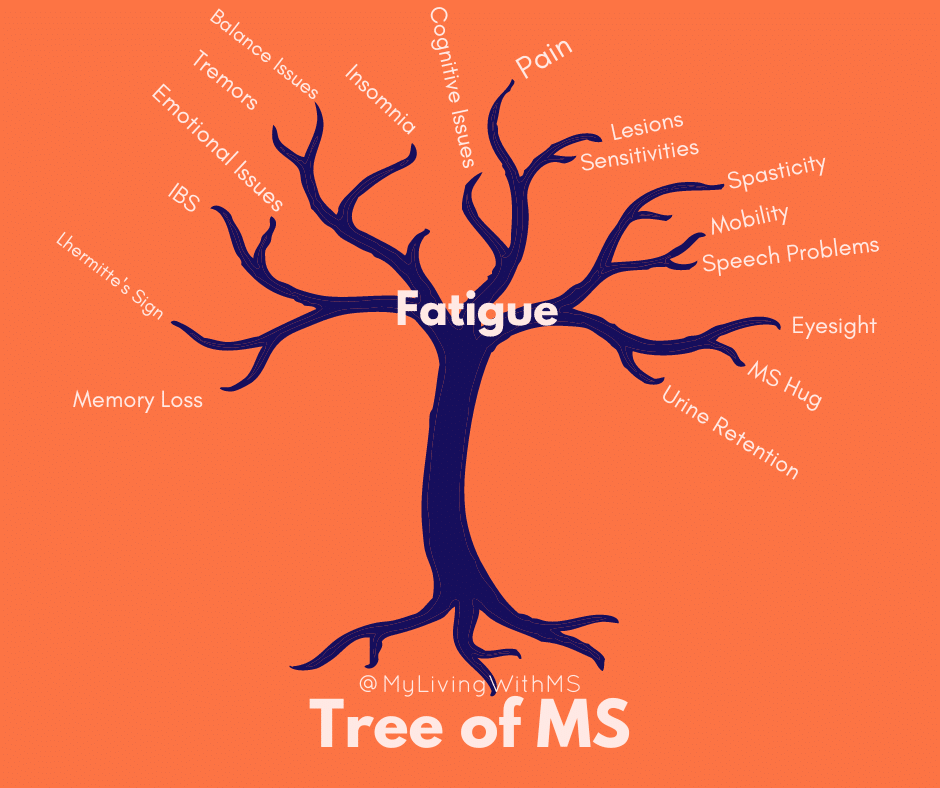
Even though I only received my official diagnosis in 2018, there are times I can go back to my early 40s and find some of the early symptoms I now live with today.
Fatigue creates so many of my symptoms and still catches me without warning today. Prior to 2018, the falling asleep issue happened many times. I thought I was “just tired”; however I often wonder if I had managed those times better. Perhaps I might not be so far on now.
Symptoms change gradually for me, so it’s harder to detect, although the deconditioning which took place throughout the pandemic, I don’t think I will ever get back.
My wheelchair, which was once an aid to preserve my energy, is now my only way of having a social life.
It depends on what the symptom is, the most worrying is MS Hug which I have had a few times now and it can go as quickly as it starts. I can only describe it as a constricting feeling in my chest, often only one side, but front and back, it can spread to the centre too though which immediately puts me in to heart attack thoughts and I have even had a blue light ambulance for it in the past.
To understand MS Hug, you need to understand what happens to my nerves which cause the muscles to in effect spasm constantly. What is called a myelin sheath covers our nerves, protecting them from exposure. In multiple sclerosis, the myelin sheath gets damaged and exposes the nerves, so when those nerves get exposed, there is nothing to stop the reaction.
It’s important to alert someone in your medical team as it isn’t always MS related and this needs ruling out quickly. I feel very fortunate to have a good relationship with both my GP and my MS nurse, which means as soon as I recognise a change or a symptom I haven’t had before I speak to my GP and follow up with my MS nurse.
When my MS hug starts, it does still panic me a little because of whereabouts it is in my chest. I feel the pain and the “hug”.
I have to manage the changes caused by my progressive MS.
In the days where they are at their worst, I rest up with a podcast/Netflix and say No to others until I manage the symptom.
How do you manage your changing symptoms?

Leave a Reply